
A nurse in an emergency department is caring for a client who is unconscious and requires emergency medical procedures. The nurse is unable to locate members of the client's family to obtain consent. Which of the following actions should the nurse take?
Contact the facility's ethics committee
Obtain consent from the client's employer
Limit care to comfort measures
Proceed with provision of medical care
The Correct Answer is D
Proceed with provision of medical care.
- A. Contact the facility's ethics committee: This is incorrect because it is not an urgent action and it does not address the client's immediate needs. The ethics committee can be consulted later if there are ethical dilemmas or conflicts regarding the client's care.
- B. Obtain consent from the client's employer: This is incorrect because it is not a valid source of consent. The employer has no legal or ethical authority to make decisions for the client, unless they are also a designated surrogate or proxy.
- C. Limit care to comfort measures: This is incorrect because it does not meet the standard of care for an emergency situation. The nurse has a duty to provide life-saving interventions for a client who is unconscious and requires emergency medical procedures, unless there is evidence of a valid advance directive that states otherwise.
- D. Proceed with provision of medical care: This is correct because it follows the principle of implied consent, which assumes that a reasonable person would consent to emergency treatment if they were able to do so. The nurse should document the circumstances and continue to search for family members or other sources of consent.
Nursing Test Bank
Naxlex Comprehensive Predictor Exams
Related Questions
Correct Answer is D
Explanation
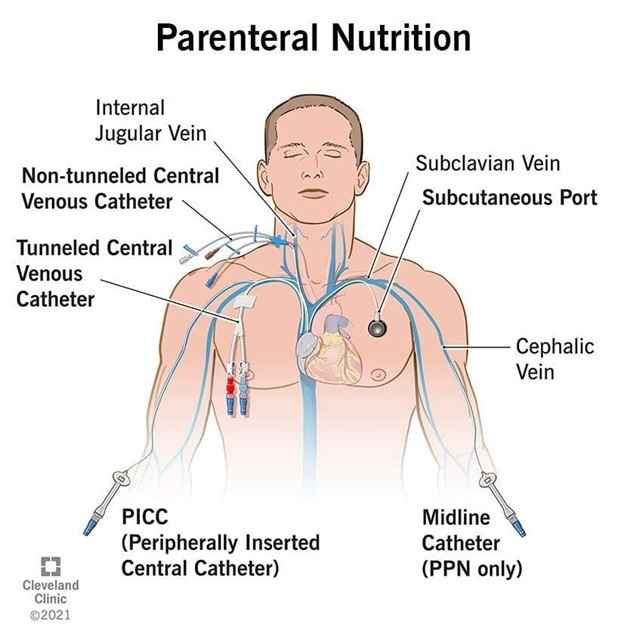
- A is incorrect because IV tubing for total parenteral nutrition should be changed every 24 hours to prevent infection.
- B is incorrect because abdominal distention is not an expected effect of total parenteral nutrition. It could indicate a complication such as fluid overload or bowel obstruction.
- C is incorrect because gastric residual is not relevant for total parenteral nutrition, which bypasses the gastrointestinal tract.
- D is correct because weight measurement is an important indicator of fluid balance and nutritional status for clients receiving total parenteral nutrition.
Correct Answer is C
Explanation
Choice A rationale:
Attaching a prefilled syringe to the catheter inflation hub is a step performed after the catheter insertion to inflate the balloon, securing the catheter in the bladder. This action is not the first step and should not be done before cleansing the meatus and positioning the sterile drape.
Choice B rationale:
Positioning the sterile drape leaving the perineum exposed is a necessary step in maintaining the sterility of the procedure area. However, it is not the first action the nurse should take. Cleaning the client's meatus with an antiseptic solution is the initial step to prevent infection during catheter insertion.
Choice C rationale:
Cleaning the client's meatus with antiseptic solution is the first step in inserting an indwelling urinary catheter. This action helps to reduce the risk of urinary tract infection by minimizing the introduction of bacteria into the urethra.
Choice D rationale:
Lubricating the catheter with water-soluble gel is a step performed after cleansing the meatus and positioning the sterile drape. It facilitates the smooth insertion of the catheter into the urethra. However, it is not the first action to be taken.
Whether you are a student looking to ace your exams or a practicing nurse seeking to enhance your expertise , our nursing education contents will empower you with the confidence and competence to make a difference in the lives of patients and become a respected leader in the healthcare field.
Visit Naxlex, invest in your future and unlock endless possibilities with our unparalleled nursing education contents today