
A nurse is caring for a child who is to receive percussion, vibration, and postural drainage. Which of the following actions should the nurse take first?
Instruct the client to cough
Perform vibration while the client exhales slowly through the nose.
Percuss the upper posterior chest.
Administer albuterol by nebulizer.
The Correct Answer is D
A. Instruct the client to cough. Coughing is generally encouraged after chest physiotherapy to help expel loosened secretions, but it is not the first action. The bronchodilator should be administered first to maximize the effectiveness of the chest physiotherapy.
B. Perform vibration while the client exhales slowly through the nose. Vibration is a component of chest physiotherapy used to help loosen secretions during exhalation, but it is performed after the bronchodilator is administered and once the client is positioned properly.
C. Percuss the upper posterior chest. Percussion helps to mobilize secretions but is typically done after the bronchodilator has been administered to allow for more effective airway clearance.
D. Administer albuterol by nebulizer. Administering albuterol first dilates the airways, making it easier to mobilize and clear secretions during percussion, vibration, and postural drainage.
Nursing Test Bank
Naxlex Comprehensive Predictor Exams
Related Questions
Correct Answer is C
Explanation
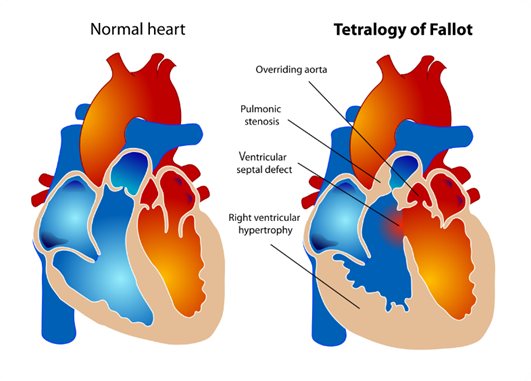
A. Overriding aorta: In Tetralogy of Fallot, the aorta is positioned over the ventricular septal defect (VSD), rather than solely over the left ventricle as it would be in a normal heart. This is called overriding aorta, which allows blood from both the right and left ventricles to enter the aorta.
B. Pulmonary stenosis: This is a critical component of Tetralogy of Fallot. Pulmonary stenosis refers to narrowing of the pulmonary valve or the area just below it, which restricts blood flow from the right ventricle to the pulmonary artery. This results in decreased blood flow to the lungs for oxygenation.
C. Left ventricular hypertrophy: This choice is not typically associated with Tetralogy of Fallot. Left ventricular hypertrophy refers to an enlargement or thickening of the muscular wall of the left ventricle of the heart. It is often seen in conditions where the left ventricle has to work harder to pump blood, such as in hypertension or aortic stenosis, but it is not a characteristic feature of Tetralogy of Fallot.
D. Ventricular septal defect: This defect is one of the four components of Tetralogy of Fallot. A ventricular septal defect (VSD) is a hole in the septum, the muscular wall that separates the left and right ventricles of the heart. In Tetralogy of Fallot, the VSD allows oxygen-poor blood from the right ventricle to flow directly into the left ventricle and out to the body.
Correct Answer is A
Explanation
A. Machine-like murmur.
This option is correct. A characteristic clinical manifestation of a large patent ductus arteriosus is a continuous "machine-like" murmur heard on auscultation. This murmur is typically heard best at the upper left sternal border and may radiate to the back.
B. Chronic hypoxemia.
Chronic hypoxemia is not typically a primary manifestation of a large PDA. While PDA can lead to increased pulmonary blood flow and potentially contribute to pulmonary congestion, chronic hypoxemia may not be a prominent feature unless complications such as heart failure develop.
C. Cyanosis with crying.
Cyanosis with crying is more commonly associated with cyanotic congenital heart defects such as tetralogy of Fallot. While PDA can contribute to cyanosis in certain circumstances, it is not typically a consistent clinical manifestation.
D. Weak pulse.
A weak pulse is not typically associated specifically with a large PDA. Infants with PDA may have bounding pulses due to increased blood flow through the ductus arteriosus.
Whether you are a student looking to ace your exams or a practicing nurse seeking to enhance your expertise , our nursing education contents will empower you with the confidence and competence to make a difference in the lives of patients and become a respected leader in the healthcare field.
Visit Naxlex, invest in your future and unlock endless possibilities with our unparalleled nursing education contents today