
A nurse is providing teaching to a client who is primigravid and is scheduled to have an abdominal ultrasound.
Which of the following statements by the client indicates an understanding of the teaching?
"I will drink water before the test until my bladder feels full.”
"I can't have anything to eat after midnight.”
"I won't apply perfumed lotion to my abdomen before the test.”
"I need to take a stool softener the night before the test.”
The Correct Answer is A
“I will drink water before the test until my bladder feels full.” Drinking water before an abdominal ultrasound is usually recommended to ensure a full bladder.
Choice B is incorrect because fasting for 8-12 hours before an abdominal ultrasound is usually recommended.
Choice C is incorrect because there is no information found that suggests avoiding perfumed lotion on the abdomen before an abdominal ultrasound.
Choice D is incorrect because there is no information found that suggests taking a stool softener before an abdominal ultrasound.
Nursing Test Bank
Naxlex Comprehensive Predictor Exams
Related Questions
Correct Answer is C
Explanation
The Babinski reflex, also known as the plantar reflex, is a normal reflex in infants
that occurs when the sole of the foot is stroked from heel to toe.
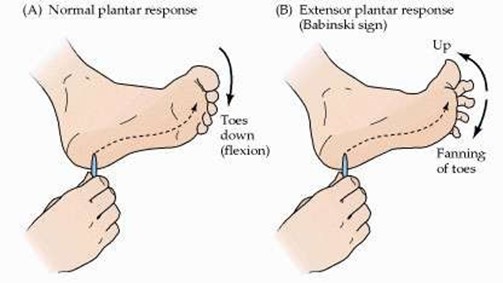
In response to this stimulus, the big toe moves upward or toward the top surface of the foot and the other toes fan out.
Choice A is not an answer because flexion of the forearm is not a response to stimulation of the foot.
Choice B is not an answer because downward curl of the toes is not a response
to stimulation of the foot.
Choice D is not an answer because extension of the leg is not a response to
stimulation of the foot.
Correct Answer is B
Explanation
If a prolapsed cord is identified, the nurse should perform a vaginal examination and ensure the presenting part is pushed upwards to relieve pressure on the cord.
Choice A) is not correct because while it is important to cover the cord with a sterile saline saturated towel if it has prolapsed externally 1, it is not the next action after calling for assistance and notifying the provider.
Choice C) is not correct because administering oxygen via non-rebreather mask at 8 L/min is not mentioned as an immediate intervention for a prolapsed cord .
Choice D) is not correct because initiating an infusion of IV fluids for the client is not mentioned as an immediate intervention for a prolapsed cord .
Whether you are a student looking to ace your exams or a practicing nurse seeking to enhance your expertise , our nursing education contents will empower you with the confidence and competence to make a difference in the lives of patients and become a respected leader in the healthcare field.
Visit Naxlex, invest in your future and unlock endless possibilities with our unparalleled nursing education contents today