
A nurse is reviewing the chart of a client who is 2 days postpartum following a vaginal delivery and reports constipation.
Which of the following findings should the nurse identify as a contraindication to the use of a suppository?
Abdominal distention
Afterpains
Vaginal candidiasis
Third-degree perineal laceration.
The Correct Answer is D
A third-degree perineal laceration is a tear that extends through the vaginal tissue, perineal skin, and perineal muscles and involves the anal sphincter.
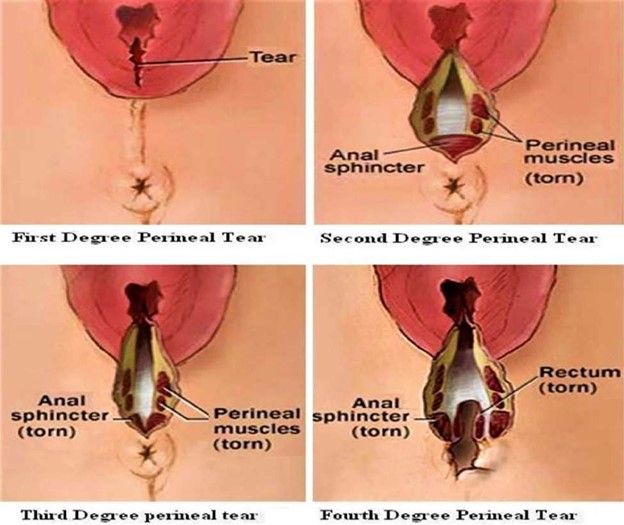
This type of laceration requires careful repair and management to prevent complications such as infection, fecal incontinence, and pain.
Choice A is incorrect because abdominal distention is not a contraindication to the use of a suppository.
Choice B is incorrect because afterpains are common postpartum uterine contractions and are not a contraindication to the use of a suppository.
Choice C is incorrect because vaginal candidiasis is a fungal infection and is not a contraindication to the use of a suppository.
Nursing Test Bank
Naxlex Comprehensive Predictor Exams
Related Questions
Correct Answer is A
Explanation
A nuchal cord occurs when the umbilical cord wraps around the fetal neck completely or for 360 degrees.
In some cases, a tight nuchal cord can cause conjunctival hemorrhage and petechiae.
Choice B) is not correct because erythema toxicum is a common rash seen in newborns and is not related to a nuchal cord.
Choice C) is not correct because periauricular papillomas are benign skin growths near the ear and are not related to a nuchal cord.
Choice D) is not correct because telangiectatic nevi, also known as stork bites or salmon patches, are common birthmarks seen in newborns and are not related to a nuchal cord.
Correct Answer is B
Explanation
Congenital CMV can cause birth defects and other long-term health problems such as hearing loss.
Hearing loss may be present at birth or may develop later in babies who passed their newborn hearing test.
Choice A is incorrect because cataracts are not mentioned as a symptom of congenital CMV.
Choice C is incorrect because urinary tract infection is not mentioned as a symptom of congenital CMV.
Choice D is incorrect because macrosomia is not mentioned as a symptom of congenital CMV.
Whether you are a student looking to ace your exams or a practicing nurse seeking to enhance your expertise , our nursing education contents will empower you with the confidence and competence to make a difference in the lives of patients and become a respected leader in the healthcare field.
Visit Naxlex, invest in your future and unlock endless possibilities with our unparalleled nursing education contents today