
A nurse is reviewing the medical records of five clients. For which of the following events should the nurse write an incident report? (Select all that apply.)
An approximate amount of urine was recorded after the urine leaked from the client's catheter bag.
A client received an 0900 daily medication at 1000.
A client who has an infection refused the evening meal.
A client received the first dose of an antibiotic 1 hr before the collection of blood for culture and sensitivity testing.
A client fell when ambulating to the bathroom alone.
Correct Answer : A,B,E
The nurse should write an incident report for the following events:
1. An approximate amount of urine was recorded after the urine leaked from the client's catheter bag. This indicates a potential issue with the catheter or its proper functioning, which needs to be documented and addressed.
2. A client received an 0900 daily medication at 1000. This is a medication administration error as the medication was given later than the prescribed time. Medication errors should be reported and documented to ensure proper follow-up and prevent future occurrences.
3. A client fell when ambulating to the bathroom alone. Falls are considered significant incidents and should always be documented and reported to ensure appropriate evaluation, intervention, and prevention of future falls.
The following events do not require an incident report:
A client who has an infection refused the evening meal. While it is important to document a client's refusal of meals, it does not typically warrant an incident report unless there are specific concerns related to the client's health or safety.
A client received the first dose of an antibiotic 1 hr before the collection of blood for culture and sensitivity testing. This may not require an incident report unless there are specific
circumstances or contraindications related to the timing of the antibiotic administration and blood collection, which need to be documented and reviewed.
Nursing Test Bank
Naxlex Comprehensive Predictor Exams
Related Questions
Correct Answer is B
Explanation
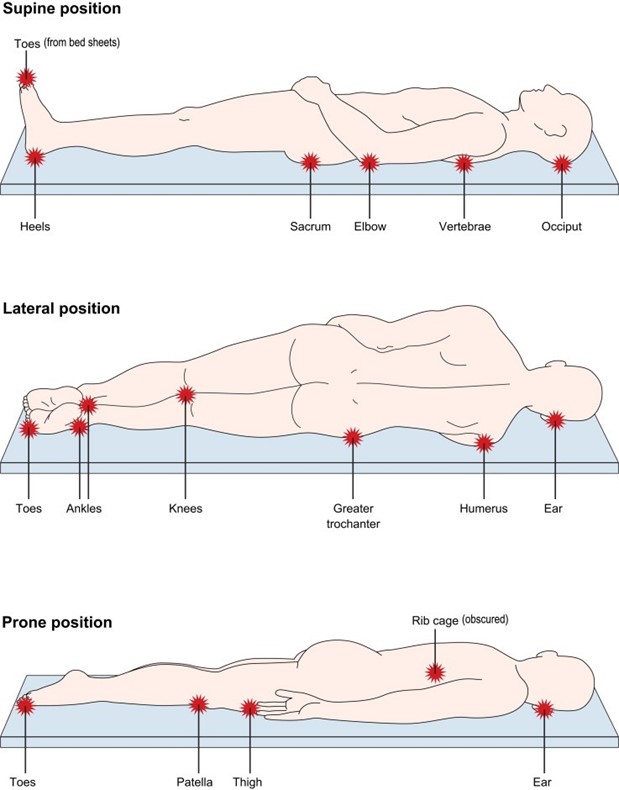
The occiput refers to the back of the head. Placing a small pillow or padding under the occiput can help relieve pressure and provide support to the client's head and neck when they are placed in the supine position.
Breasts: When in the prone position, breasts may be compressed or flattened. To relieve pressure, it may be necessary to use positioning techniques that distribute weight evenly and avoid direct pressure on the breasts, such as using cushions or foam pads to support the chest and torso.
Heels: The heels are prone to pressure ulcers when a client is lying in the supine position for extended periods. To relieve pressure, it is important to use proper heel offloading techniques, such as placing heel protectors or pillows under the lower legs to elevate the heels off the bed surface and prevent direct pressure.
Coccyx: The coccyx is the tailbone region at the base of the spine. When in the supine position, pressure on the coccyx can be relieved by using a cushion or padding under the pelvic area, specifically under the bony prominence of the coccyx, to reduce direct pressure and provide comfort.
Correct Answer is D
Explanation
A. Incorrect. The cause of death is an important piece of information but is typically included in the official death certificate rather than in routine postmortem documentation.
B. Incorrect. While vital signs are important during the client's care, the last set of vital signs is not usually a primary focus of postmortem documentation.
C. Incorrect. Advance directives are relevant to the client's care during life but are not typically included in postmortem documentation.
D. Correct. Documentation of the location of the identification tag on the client's body is important for accurate identification and tracking during the postmortem process.
Whether you are a student looking to ace your exams or a practicing nurse seeking to enhance your expertise , our nursing education contents will empower you with the confidence and competence to make a difference in the lives of patients and become a respected leader in the healthcare field.
Visit Naxlex, invest in your future and unlock endless possibilities with our unparalleled nursing education contents today