
The nurse observes the following rhythm of a client on the telemetry unit.
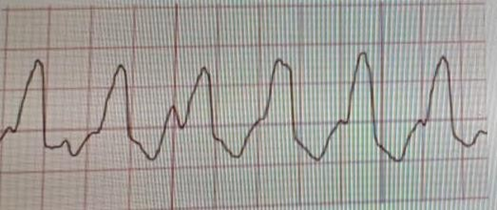
Which action should be completed first?
Report the findings and anticipate a medical prescription for amiodarone
Initiate a rapid response call and increase the monitor's sensitivity
Start compressions and prepare for defibrillation
Establish unresponsiveness and check the carotid pulse
The Correct Answer is D
A. Reporting the findings and anticipating a prescription for amiodarone may be necessary later, but the first step is to assess the patient's immediate condition (unresponsiveness, pulse status, etc.).
B. Although increasing monitor sensitivity and initiating a rapid response call might be helpful, these actions come after assessing the patient’s condition. If the patient is in distress or unresponsive, the nurse needs to check for a pulse and intervene right away.
C. This is a crucial action if the patient is unresponsive and pulseless (cardiac arrest). If the patient is found to be unresponsive and pulseless, starting chest compressions immediately and preparing for defibrillation is the next step. However, the first action is to check for pulse and responsiveness.
Why it's incorrect: Compressions and defibrillation are correct actions if the patient is pulseless, but before taking these steps, the nurse must assess the patient for responsiveness and check the carotid pulse. Starting CPR and preparing defibrillation without verifying the patient's condition could delay appropriate care.
D. Checking responsiveness and pulse is the most immediate and critical action because VT may be asymptomatic or cause deterioration, including cardiac arrest. Once pulse and responsiveness are determined, appropriate interventions (such as defibrillation or CPR) can be initiated quickly.
Nursing Test Bank
Naxlex Comprehensive Predictor Exams
Related Questions
Correct Answer is A
Explanation
A. Clients with left-sided heart failure often experience symptoms like shortness of breath, fatigue, and fluid retention, which limit physical activity. However, they may still feel relatively comfortable when resting.
B. These symptoms are more commonly associated with allergic reactions or side effects of medications (such as ACE inhibitors) rather than heart failure.
C. This is not typical in the later stages of left-sided heart failure. In fact, clients may experience reduced urine output due to poor kidney perfusion.
D. Chest pain can occur due to ischemia, but this is not a hallmark symptom of left-sided heart failure, which is more characterized by dyspnea and fatigue.
Correct Answer is ["11"]
Explanation
The patient weighs 121 lbs, which is approximately 55 kilograms (121 ÷ 2.2).
Next, multiply the patient's weight in kilograms by the dosage prescribed, which is 20 units/kg. This results in a total dosage of 1100 units (55 kg × 20 units/kg).
The medication is supplied as 25,000 units in 250 mL, so to find out how many mL of medication is needed, set up a proportion: 25,000 units is to 250 mL as 1100 units is to X mL. Solving for X gives you 11 mL (1100 units × 250 mL ÷ 25,000 units).
Therefore, the nurse will administer 11 mL of Heparin to the patient.
Whether you are a student looking to ace your exams or a practicing nurse seeking to enhance your expertise , our nursing education contents will empower you with the confidence and competence to make a difference in the lives of patients and become a respected leader in the healthcare field.
Visit Naxlex, invest in your future and unlock endless possibilities with our unparalleled nursing education contents today