
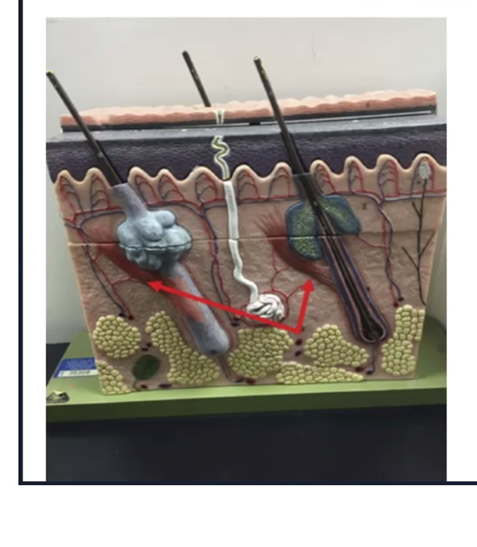
What structure is indicated by the arrows?
Sebaceous Gland
Sweat Gland
Arrector Pili Muscle
Dermal Papilla
The Correct Answer is C
A. Sebaceous Gland: These are oil-producing glands visible in the model as multi-lobed structures near the hair root, but they are not the specific band-like structure indicated by the arrows.
B. Sweat Gland: The model shows eccrine sweat glands as coiled white structures, whereas the arrows point to a reddish, contractile tissue.
C. Arrector Pili Muscle: These are small bands of smooth muscle cells that connect the hair follicle to the upper dermis. When they contract, they cause the hair to stand upright (forming "goosebumps").
D. Dermal Papilla: This refers to the finger-like projections at the epidermal-dermal junction, not the deeper muscle tissue attached to the follicle.
Nursing Test Bank
Naxlex Comprehensive Predictor Exams
Related Questions
Correct Answer is A
Explanation
A. Chromatid: In this chromosome model, the pink structure represents the chromatid, and the red coiled section highlights a specific portion of the DNA molecule.
B. Centromere: This is the constricted region of the chromosome that attaches to spindle fibers during cell division, not the highlighted locus.
C. Telomere: These are repetitive DNA sequences at the ends of chromosomes that protect against degradation, not the middle region.
D. Histone protein: These are proteins around which DNA winds to form nucleosomes, but they are not visible as a distinct locus on a chromosome model.
Correct Answer is A
Explanation
A. Simple cuboidal epithelium: The nephron tubules (such as the proximal and distal convoluted tubules, and parts of the collecting duct) are lined with simple cuboidal epithelial cells. These cells are specialized for secretion and reabsorption, which are essential functions in urine formation. Their cube-like shape allows for a balance between structural support and metabolic activity.
B. Stratified squamous epithelium: Found in areas subject to friction, such as the skin and esophagus, not in nephron tubules.
C. Transitional epithelium: Specialized for stretching, found in the urinary bladder and ureters, not in the nephron.
D. Simple columnar epithelium: Taller cells found in the gastrointestinal tract, not in kidney tubules.
Simple columnar epithelium: Taller cells found in the gastrointestinal tract, not in kidney tubules.
Whether you are a student looking to ace your exams or a practicing nurse seeking to enhance your expertise , our nursing education contents will empower you with the confidence and competence to make a difference in the lives of patients and become a respected leader in the healthcare field.
Visit Naxlex, invest in your future and unlock endless possibilities with our unparalleled nursing education contents today