
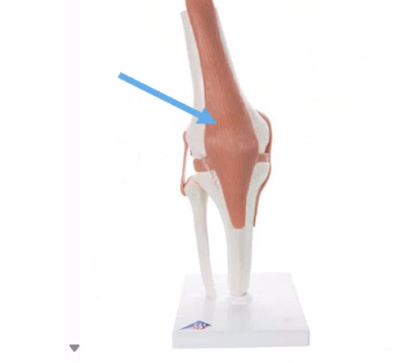
What type of tissue is seen here?
Cardiac Muscle Tissue
Skeletal Muscle Tissue
Fibrocartilage
Dense Regular Connective Tissue
The Correct Answer is B
A. Cardiac Muscle Tissue: This tissue is found exclusively in the walls of the heart to facilitate involuntary rhythmic contractions. It is not found in the limbs.
B. Skeletal Muscle Tissue: This tissue is attached to bones and is responsible for voluntary movement. The arrow points to the quadriceps femoris group, which is composed of skeletal muscle fibers.
C. Fibrocartilage: While present in the knee (as the menisci), fibrocartilage is a tough, shock-absorbing tissue found between bones, not in the large, reddish contractile mass indicated by the arrow.
D. Dense Regular Connective Tissue: This tissue forms tendons and ligaments. While a tendon (the patellar tendon/ligament) is visible just below the arrow, the arrow specifically points to the belly of the muscle.
Nursing Test Bank
Naxlex Comprehensive Predictor Exams
Related Questions
Correct Answer is B
Explanation
A. Skeletal muscle tissue: Shows striations and multiple peripheral nuclei, not clear vacuoles.
B. Adipose tissue: Adipose tissue is a specialized connective tissue made up of adipocytes (fat cells). Each cell has a large central vacuole filled with lipid, which pushes the nucleus to the periphery, giving the cells a clear, empty appearance under the microscope. This tissue functions in energy storage, insulation, and cushioning of organs. The slide’s large, round cells with clear centers are characteristic of adipose tissue.
C. Nervous tissue: Contains neurons with branching processes, not round fat cells.
D. Stratified squamous epithelium: Forms protective layers of flat cells, not large vacuolated adipocytes.
Correct Answer is B
Explanation
A. Cardiac Muscle Tissue: This tissue is found exclusively in the walls of the heart to facilitate involuntary rhythmic contractions. It is not found in the limbs.
B. Skeletal Muscle Tissue: This tissue is attached to bones and is responsible for voluntary movement. The arrow points to the quadriceps femoris group, which is composed of skeletal muscle fibers.
C. Fibrocartilage: While present in the knee (as the menisci), fibrocartilage is a tough, shock-absorbing tissue found between bones, not in the large, reddish contractile mass indicated by the arrow.
D. Dense Regular Connective Tissue: This tissue forms tendons and ligaments. While a tendon (the patellar tendon/ligament) is visible just below the arrow, the arrow specifically points to the belly of the muscle.
Whether you are a student looking to ace your exams or a practicing nurse seeking to enhance your expertise , our nursing education contents will empower you with the confidence and competence to make a difference in the lives of patients and become a respected leader in the healthcare field.
Visit Naxlex, invest in your future and unlock endless possibilities with our unparalleled nursing education contents today