
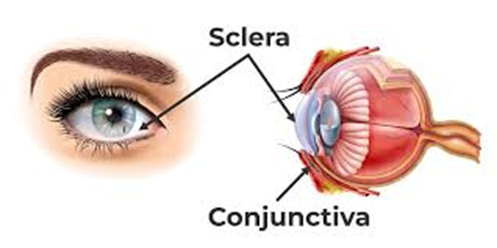
When preparing to examine a client's sclera and conjunctiva during an eye examination, the nurse should instruct the client to move both eyes to look in which direction?
Down
To the left
To the right
Up
The Correct Answer is D
Choice A Reason:
Looking down does not typically expose the sclera and conjunctiva for examination. The lower eyelid covers more of the sclera when the eyes are directed downward, making it less accessible for observation.
Choice B Reason:
Moving the eyes to the left is not the standard direction for examining the sclera and conjunctiva. This movement would not provide an optimal view of the entire sclera and conjunctiva, as it would only stretch the lateral part of the conjunctiva.
Choice C Reason:
Directing the eyes to the right, similar to moving them to the left, does not offer the best exposure for examining the sclera and conjunctiva. The medial part of the conjunctiva would be stretched, but the rest would not be easily visible.
Choice D Reason:
Instructing the client to look up is the correct procedure when examining the sclera and conjunctiva. By looking upward, the client exposes more of the sclera and the palpebral conjunctiva, allowing the nurse to inspect these areas thoroughly for any abnormalities such as redness, swelling, or foreign bodies.
Nursing Test Bank
Naxlex Comprehensive Predictor Exams
Related Questions
Correct Answer is B
Explanation
Choice A reason:
Discussing reactions to allergens typically focuses on environmental or food triggers that may cause allergic reactions. While it's important to understand a client's allergies, this topic is not closely related to alcohol use, which has different implications for health and lifestyle choices.
Choice B reason:
Asking about alcohol use naturally follows the discussion about cigarette smoking because both involve substance use and have potential health risks. It allows the nurse to transition smoothly from one lifestyle factor to another, which can impact the client's overall health. This approach also helps in creating a comprehensive picture of the client's habits that may contribute to or affect their current health status.
Choice C reason:
Reviewing current medications is an essential part of the health history, as it can reveal potential interactions with alcohol. However, it might be more appropriate to ask about alcohol use after discussing other lifestyle habits such as smoking, as they are more directly related. Once the client's substance use habits are established, the nurse can then discuss how these might interact with prescribed medications.
Choice D reason:
Asking about previous surgeries is important for understanding a client's medical history, but it is not directly related to the client's current lifestyle habits like alcohol use. Therefore, it would be more natural to ask about alcohol use in the context of other substance use discussions rather than after surgical history.
Correct Answer is A
Explanation
Choice A reason:
A formal hearing test, or audiometry, is the most comprehensive method for assessing hearing loss, which can be a side effect of ototoxic medications. These tests can detect both conductive and sensorineural hearing loss, providing a detailed profile of hearing function across different frequencies. For clients receiving ototoxic antibiotics, regular monitoring through formal hearing tests is recommended to detect any early signs of hearing impairment and to implement timely interventions.
Choice B reason:
The rubbing fingers test is a rudimentary hearing screening method where the examiner rubs their fingers together near the patient's ear, asking them to indicate when they hear the sound. While this test can be used as a quick check for hearing loss, it is not as sensitive or specific as formal audiometry and may not detect early or mild hearing loss caused by ototoxic drugs.
Choice C reason:
Tuning fork tests, such as the Weber and Rinne tests, are used to differentiate between conductive and sensorineural hearing loss. These tests can be useful in a clinical setting to provide immediate information about the type of hearing loss; however, they are not as comprehensive as formal hearing tests and may not be sufficient for monitoring ototoxicity.
Choice D reason:
The whisper hearing test involves the examiner whispering words or numbers and asking the patient to repeat them. This test can be useful for detecting significant hearing loss but may not be sensitive enough to detect the early stages of ototoxicity. Moreover, the test's accuracy can be affected by the examiner's voice level and the testing environment.
Whether you are a student looking to ace your exams or a practicing nurse seeking to enhance your expertise , our nursing education contents will empower you with the confidence and competence to make a difference in the lives of patients and become a respected leader in the healthcare field.
Visit Naxlex, invest in your future and unlock endless possibilities with our unparalleled nursing education contents today