
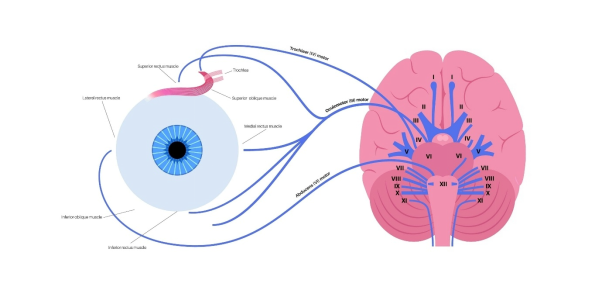
Which cranial nerve is responsible for eye movement and is often assessed in a neurological exam?
Oculomotor nerve (CN III)
Facial nerve (CN VII)
Optic nerve (CN II)
Trigeminal nerve (CNV)
The Correct Answer is A
A. Oculomotor nerve (CN III): The Oculomotor nerve controls the majority of the extraocular muscles (superior, inferior, and medial rectus, and inferior oblique). It is responsible for moving the eye upward, downward, and inward, as well as lifting the eyelid and constricting the pupil.
B. Facial nerve (CN VII): The Facial nerve primarily controls muscles of facial expression (smiling, closing eyes tightly) and taste sensations, not the movement of the eyeball itself.
C. Optic nerve (CN II): The Optic nerve is a sensory nerve responsible for vision (sight). It transmits visual information from the retina to the brain but has no motor function to move the eye.
D. Trigeminal nerve (CN V): The Trigeminal nerve is primarily responsible for facial sensation (touch, pain, temperature) and the motor muscles of mastication (chewing). It does not control eye movement.
Nursing Test Bank
Naxlex Comprehensive Predictor Exams
Related Questions
Correct Answer is A
Explanation
A. Enteric nervous system:The Enteric nervous system is a mesh-like system of neurons that governs the function of the gastrointestinal tract (the "brain of the gut"). It manages digestion, not the systemic stress response.
B. Central nervous system:While the brain (specifically the hypothalamus and amygdala) perceives the threat, the execution of the physiological "fight or flight" changes (racing heart, dilated pupils) is carried out by the autonomic nerves.
C. Peripheral nervous system:Similar to Question 45, this is a broad anatomical term. While the stress response nerves are located in the periphery, the specific functional system is the Autonomic Nervous System.
D. Autonomic nervous system:The Autonomic Nervous System has two main branches: the Sympatheticand the Parasympathetic. The Sympathetic division is directly responsible for the "fight or flight" response, mobilizing the body's energy during stress.
Question: 47 of 48
A middle-aged woman has been diagnosed with a vitamin D deficiency. How does this deficiency affect her musculoskeletal system?
- Reduced calcium absorption leading to weak bones
- Increased muscle mass
- Enhanced collagen production
- Hypercalcemia due to excess calcium
Correct answer: A
A. Reduced calcium absorption leading to weak bones:The primary physiological role of Vitamin D is to facilitate the absorption of calciumin the intestines. Without sufficient Vitamin D, the body cannot absorb enough calcium from the diet. To maintain blood calcium levels, the body will then leech calcium from the bones, leading to lower bone density (osteopenia/osteoporosis) and increased fracture risk.
B. Increased muscle mass:Vitamin D deficiency is actually associated with muscle weakness and pain (proximal myopathy), not an increase in muscle mass.
C. Enhanced collagen production:Vitamin D is not a primary driver of collagen synthesis; Vitamin C is the key nutrient for collagen production.
D. Hypercalcemia due to excess calcium:A deficiency in Vitamin D leads to hypocalcemia(low calcium levels) because the gut cannot absorb it efficiently. Hypercalcemia would be a sign of Vitamin D toxicity (overdose) or hyperparathyroidism.
Correct Answer is A
Explanation
A. Flat bone; protection of thoracic organs: Ribs are classified as flat bones (thin, flattened, often slightly curved) and their major functions include protecting thoracic organs (heart and lungs) and providing attachment sites for muscles involved in respiration and trunk movement.
B. Irregular bone; varied functions:Irregular bones (e.g., vertebrae, some facial bones) have complex shapes and varied functions; ribs are not irregular bones.
C. Short bone; stability and support:Short bones (e.g., carpals and tarsals) are roughly cube-shaped and provide stability with limited motion; ribs are not short bones.
D. Long bone; support and leverage:Long bones (e.g., femur, humerus) are longer than they are wide and function mainly in support and leverage for movement; ribs are not long bones.
Whether you are a student looking to ace your exams or a practicing nurse seeking to enhance your expertise , our nursing education contents will empower you with the confidence and competence to make a difference in the lives of patients and become a respected leader in the healthcare field.
Visit Naxlex, invest in your future and unlock endless possibilities with our unparalleled nursing education contents today