
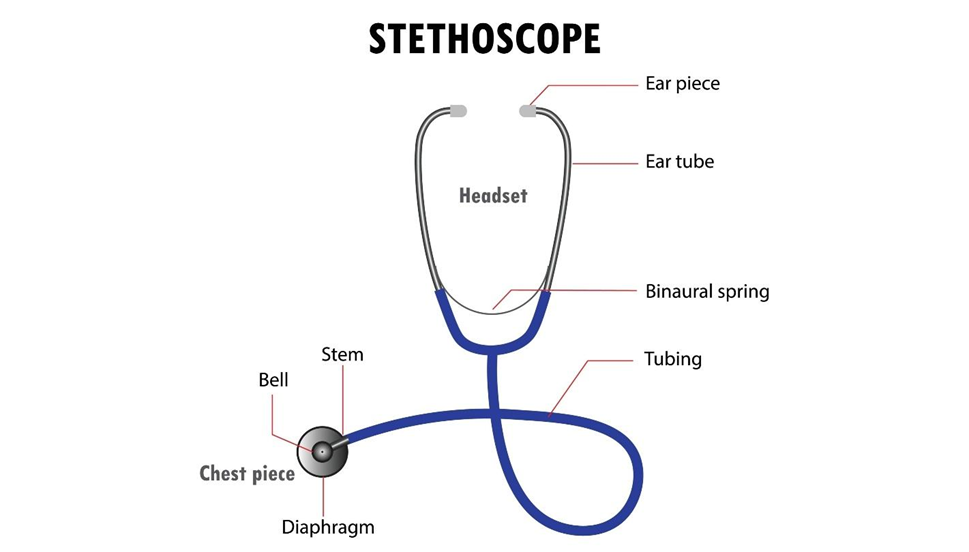
Which stethoscope component is appropriate for auscultating high-pitched heart sounds such as S1, S2, and some murmurs?
The bell
The tubing
The earpieces
The diaphragm
The Correct Answer is D
Choice A reason: The bell of the stethoscope is a concave component designed specifically for detecting low-frequency sounds, such as the S3 or S4 heart sounds or low-pitched diastolic murmurs. When placed lightly against the skin, it allows low-frequency vibrations to pass through without being dampened, making it ineffective for high-pitched sounds.
Choice B reason: The tubing is a conduit for sound waves traveling from the chest piece to the earpieces. Its length, thickness, and internal diameter are optimized to minimize sound loss and ambient noise interference, but the tubing itself has no role in the filtering or specific auscultation of high-frequency versus low-frequency heart sounds.
Choice C reason: The earpieces are designed to ensure a comfortable and secure fit in the user's ear canals to exclude external ambient noise and direct sound into the ear. They do not possess any functional mechanism for frequency discrimination or the selective enhancement of high-pitched sounds during the cardiac examination process.
Choice D reason: The diaphragm is a stiff, flat disc that effectively transmits high-frequency sounds. It functions by filtering out low-frequency sounds while permitting high-pitched sounds, such as the S1 and S2 heart sounds and certain systolic murmurs, to pass through clearly, making it the essential component for standard cardiac assessment.
Nursing Test Bank
Naxlex Comprehensive Predictor Exams
Related Questions
Correct Answer is A
Explanation
Choice A reason: Deep breathing exercises help expand the alveoli and promote optimal gas exchange. An oxygen saturation of 88% is below the normal range, indicating potential hypoxemia. Encouraging deep breaths improves ventilation, prevents atelectasis, and can help raise oxygen saturation levels by increasing the surface area available for gas diffusion in the lungs.
Choice B reason: Opioid analgesics are central nervous system depressants that can significantly decrease the respiratory rate and depth. Administering an opioid to a client who is already hypoxemic could lead to further respiratory depression, worsen the hypoxemia, and potentially result in dangerous levels of hypercapnia and respiratory failure.
Choice C reason: While coughing helps clear secretions, relying on a schedule of every 4 hours is inadequate for a client experiencing active hypoxemia. Interventions for low oxygen saturation must be immediate and continuous to restore adequate tissue perfusion, rather than waiting for a delayed, infrequent nursing task.
Choice D reason: Decreasing the head of the bed (placing the client in a supine position) increases the pressure of the abdominal organs against the diaphragm, which limits lung expansion. To improve oxygenation, the nurse should elevate the head of the bed (Fowler's or semi-Fowler's position) to maximize thoracic excursion and ventilation.
Correct Answer is D
Explanation
Choice A reason: Palpation of the thyroid gland is an assessment technique directed at evaluating the endocrine system, specifically looking for thyromegaly, nodules, or tenderness. It has no diagnostic relevance to the assessment of pupillary asymmetry or acute neurological dysfunction, making it an inappropriate next step in this specific context.
Choice B reason: While assessing vital signs is a fundamental component of a comprehensive nursing assessment, blood pressure measurement provides data on cardiovascular hemodynamics. It does not provide direct evidence regarding the etiology of anisocoria or focal neurological deficits related to cranial nerve integrity or intracranial pressure status.
Choice C reason: Vision acuity testing utilizing a Snellen chart evaluates the integrity of the optic nerve (cranial nerve 2). While vision changes can be secondary to neurological issues, it does not provide the immediate clinical data required to evaluate the pupillary reflex arc and direct brainstem function.
Choice D reason: Pupillary asymmetry, or anisocoria, requires immediate evaluation of cranial nerve 3 (oculomotor nerve) integrity. Assessing the pupillary response to light, including both direct and consensual reactions, is critical to differentiate between physiological anisocoria and pathological causes such as uncal herniation, intracranial hemorrhage, or other oculomotor nerve compressions.
Whether you are a student looking to ace your exams or a practicing nurse seeking to enhance your expertise , our nursing education contents will empower you with the confidence and competence to make a difference in the lives of patients and become a respected leader in the healthcare field.
Visit Naxlex, invest in your future and unlock endless possibilities with our unparalleled nursing education contents today