
A nurse is collecting data from a client who has rheumatoid arthritis. Which of the following is an expected finding for this client?
Tophi
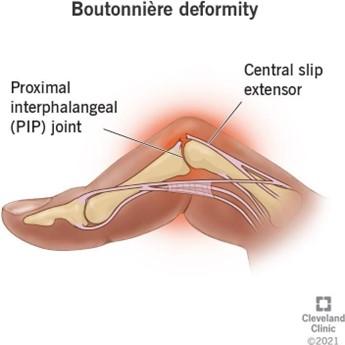
Boutonniere deformity
Osteoma
Heberden's nodules
The Correct Answer is B
Boutonniere deformity is an expected finding for a client who has rheumatoid arthritis. It is a type of hand deformity that can occur in people with rheumatoid arthritis. It is characterized by a bent middle finger joint and a hyperextended fingertip.
Tophi, osteoma, and Heberden's nodules are not expected findings for a client who has rheumatoid arthritis. Tophi are deposits of uric acid crystals that can occur in people with gout. Osteoma is a benign bone tumour. Heberden's nodules are bony growths that can occur in people with osteoarthritis.
Nursing Test Bank
Naxlex Comprehensive Predictor Exams
Related Questions
Correct Answer is D
Explanation
The nurse should reinforce to the client that Buck's traction promotes relief from muscle spasms. Buck's traction is a type of skin traction that is widely used for fractures of the femur and hip². It uses splints, bandages, and adhesive tapes to position a limb near the fracture and then applies pressure using weights and pulleys. One of the goals of Buck's traction is to lessen or eliminate muscular spasms.
a. Reduction of the fracture is not the primary purpose of Buck's traction.
b. Support for moving the extremity is not a primary outcome of Buck's traction.
c. Alignment of the pins is not applicable to Buck's traction as it does not involve inserting pins into the
bone.
Correct Answer is ["C","D","E"]
Explanation
Keeping a night light on in the client's room and bathroom can help reduce the risk of falls by improving visibility and orientation at night. Placing the bedside table within the client's reach can help reduce the risk of falls by making it easier for the client to access necessary items without having to get up and move around. Locking the wheels on beds and wheelchairs during transfers can help reduce the risk of falls by providing stability and preventing unwanted movement.
Keeping the bed at a comfortable working height is important for the nurse's comfort and safety while providing care, but it does not directly reduce the risk of falls for the client.
Administering a sedative at bedtime may help the client sleep, but it can also increase the risk of falls by causing drowsiness and disorientation.
Whether you are a student looking to ace your exams or a practicing nurse seeking to enhance your expertise , our nursing education contents will empower you with the confidence and competence to make a difference in the lives of patients and become a respected leader in the healthcare field.
Visit Naxlex, invest in your future and unlock endless possibilities with our unparalleled nursing education contents today