
A nurse is considering ethical principles during rounds. Which nursing statement demonstrates the principle of fidelity?
"All patients should be treated fairly, regardless of age, gender, or income."
"We want to prevent harm by minimizing risk."
"You will feel some discomfort during this procedure."
"I have returned immediately, as promised, with your pain medication."
The Correct Answer is D
D. This statement exemplifies the ethical principle of fidelity, also known as faithfulness or commitment. Fidelity involves keeping promises, being reliable, and fulfilling commitments made to patients. By returning promptly with the pain medication as promised, the nurse demonstrates fidelity by honoring their commitment to the patient's care and comfort.
A. This statement reflects the ethical principle of justice, which emphasizes fairness and equality in treatment for all patients. Justice ensures that resources and treatments are distributed fairly among individuals.
B This statement demonstrates the ethical principle of nonmaleficence, which focuses on preventing harm and minimizing risks to patients. It emphasizes the nurse's commitment to avoiding harm or injury to the patient.
C. This statement relates to truth-telling or veracity, which involves providing honest and accurate information to patients about their care, procedures, and potential outcomes. It reflects transparency and respect for patient autonomy.
Nursing Test Bank
Naxlex Comprehensive Predictor Exams
Related Questions
Correct Answer is B
Explanation
B. This finding suggests deep tissue involvement and is characteristic of a Stage IV pressure injury. Stage IV pressure injuries involve full-thickness tissue loss with exposure of underlying structures such as bone, tendon, or muscle. This level of tissue damage requires extensive wound care and management to promote healing.
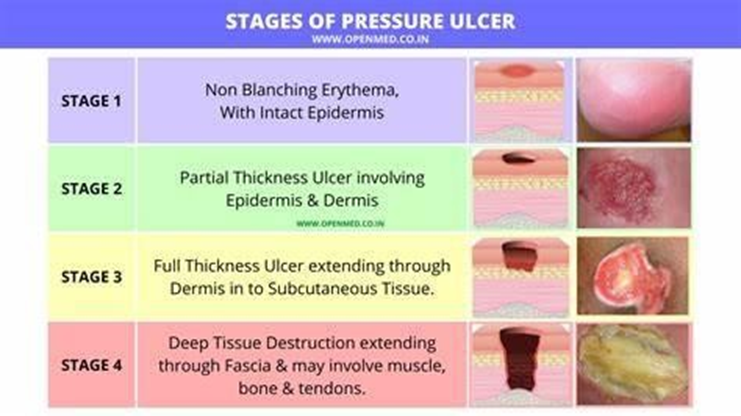
A. Thick dark eschar indicates necrotic tissue that typically covers the wound. While eschar itself is a characteristic of severe wounds, its presence alone does not define a Stage IV pressure injury. Eschar can be present in various stages of pressure injuries.
C. Partial-thickness loss of dermis typically corresponds to Stage II pressure injuries, where the injury extends into the epidermis and dermis but does not yet involve full-thickness tissue loss. This finding does not indicate a Stage IV pressure injury.
D. This finding is characteristic of a Stage III pressure injury, where the wound extends through the dermis into the subcutaneous tissue layer. In Stage IV pressure injuries, the damage progresses further to involve deeper structures such as muscle and bone, beyond the subcutaneous tissue.
Correct Answer is A
Explanation
A. The pulmonic valve is best auscultated at the second intercostal space (ICS) on the left sternal border. This is where the area corresponding to the pulmonic valve is most accurately heard due to the anatomical positioning of the heart.
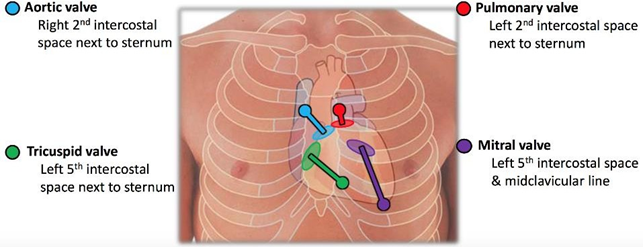
B. This area does not correspond to any valvular area.
C. This location corresponds to the aortic valve, not the pulmonic valve. The aortic valve is best auscultated at the second ICS, right sternal border.
D. This location corresponds to the tricuspid valve, not the pulmonic valve. The tricuspid valve is best auscultated at the fourth or fifth ICS along the left sternal border.
Whether you are a student looking to ace your exams or a practicing nurse seeking to enhance your expertise , our nursing education contents will empower you with the confidence and competence to make a difference in the lives of patients and become a respected leader in the healthcare field.
Visit Naxlex, invest in your future and unlock endless possibilities with our unparalleled nursing education contents today