
Ordered: Dopamine2mcg/kg/min In Stock: 200mg in 250mL Saline Patients weight: 60kg What rate would you set the pump to deliver the ordered medication? (Document to the nearest whole number)
The Correct Answer is ["9"]
-
Dose in mcg/min=2 mcg/kg/min×60 kg=120 mcg/min
Convert this to mg/min since the concentration is in mg:
120 mcg/min=0.12 mg/min120 \text{ mcg/min} = 0.12 \text{ mg/min}120 mcg/min=0.12 mg/min
-
Determine the concentration of Dopamine:
- Total amount of Dopamine: 200 mg in 250 mL of saline
- Concentration:
Concentration=200 mg250 mL=0.8 mg/mL\text{Concentration} = \frac{200 \text{ mg}}{250 \text{ mL}} = 0.8 \text{ mg/mL}Concentration=250 mL200 mg=0.8 mg/mL
-
Calculate the pump rate in mL/min:
To find the rate in mL/min needed to deliver 0.12 mg/min:
Pump rate=Desired dose (mg/min)Concentration (mg/mL)\text{Pump rate} = \frac{\text{Desired dose (mg/min)}}{\text{Concentration (mg/mL)}}Pump rate=Concentration (mg/mL)Desired dose (mg/min)
Pump rate=0.12 mg/min0.8 mg/mL=0.15 mL/min\text{Pump rate} = \frac{0.12 \text{ mg/min}}{0.8 \text{ mg/mL}} = 0.15 \text{ mL/min}Pump rate=0.8 mg/mL0.12 mg/min=0.15 mL/min
-
Convert the pump rate to mL/hour:
Multiply by 60 to convert from mL/min to mL/hour:
Pump rate=0.15 mL/min×60 min/hour=9 mL/hour\text{Pump rate} = 0.15 \text{ mL/min} \times 60 \text{ min/hour} = 9 \text{ mL/hour}Pump rate=0.15 mL/min×60 min/hour=9 mL/hour
So, you should set the pump to deliver Dopamine at a rate of 9 mL/hour.
Nursing Test Bank
Naxlex Comprehensive Predictor Exams
Related Questions
Correct Answer is B
Explanation
Positioning the transducer level with the phlebostatic axis is a crucial step in accurate hemodynamic monitoring. The phlebostatic axis is an imaginary reference point located at the fourth intercostal space, mid-anterior/posterior chest. Placing the transducer at this level ensures that the pressure measurements obtained are reflective of the patient's true hemodynamic status.
A. Positioning the limb with the catheter insertion site at the level of the transducer in (option A) is incorrect because: While it is important to position the limb appropriately to avoid kinks or occlusions in the catheter tubing, this is not directly related to the accurate measurement of hemodynamic parameters.
C. Ensuring that the patient is lying with the head of the bed flat for all readings in (option C) is incorrect because The position of the patient's head does not directly impact the accuracy of hemodynamic monitoring unless it specifically relates to changes in preload or intracranial pressure monitoring.
D. Balancing and calibrating the hemodynamic monitoring equipment every hour in (option D) is incorrect because: While it is important to ensure that the monitoring equipment is calibrated and functioning properly, doing so every hour may not be necessary. Calibration frequency may vary based on institutional policies and patient stability.
Therefore, the correct action that demonstrates effective teaching about hemodynamic monitoring is positioning the transducer level with the phlebostatic axis.
Correct Answer is A
Explanation
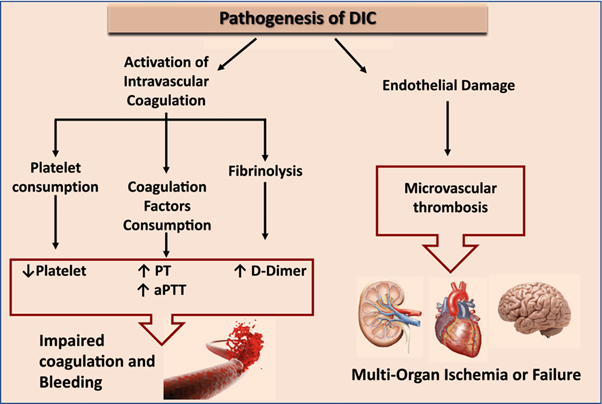
Disseminated intravascular coagulation (DIC) is a condition characterized by both widespread activation of the coagulation system and excessive clotting, leading to the consumption of clotting factors and platelets. This results in a prothrombotic state, which can lead to organ dysfunction and bleeding manifestations.
Elevated D-dimer levels are a characteristic finding in DIC. D-dimer is a fibrin degradation product that is elevated when there is excessive fibrin formation and breakdown. Elevated D-dimer indicates ongoing fibrinolysis and activation of the clotting system.
B. Decreased prothrombin time in (option B) is incorrect because: DIC is characterized by consumption of clotting factors, which can result in prolongation of the prothrombin time (PT) as well as other coagulation tests.
C. Decreased partial thromboplastin time in (option C) is incorrect because Similar to the prothrombin time, the partial thromboplastin time (PTT) can also be prolonged in DIC due to the consumption of clotting factors.
D. Elevated fibrinogen level in (option D) is incorrect because, In DIC, there is consumption of fibrinogen along with other clotting factors. Therefore, elevated fibrinogen levels are not consistent with the pathophysiology of DIC.
Whether you are a student looking to ace your exams or a practicing nurse seeking to enhance your expertise , our nursing education contents will empower you with the confidence and competence to make a difference in the lives of patients and become a respected leader in the healthcare field.
Visit Naxlex, invest in your future and unlock endless possibilities with our unparalleled nursing education contents today