
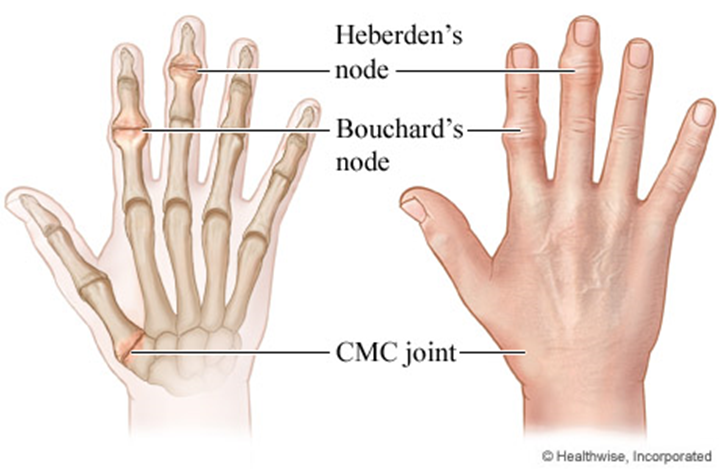
While assessing a client with degenerative joint disease, the nurse observes Heberden's nodes, large prominences on the client's fingers that are reddened. The client reports that the nodes are painful. Which action should the nurse take?
Discuss approaches to chronic pain control with the client.
Review the client's dietary intake of high-protein foods.
Notify the healthcare provider of the finding immediately.
Assess the client's radial pulses and capillary refill time.
The Correct Answer is A
A. Discuss approaches to chronic pain control with the client:
This is the correct answer. Heberden's nodes are bony enlargements that can occur in osteoarthritis, particularly in the joints of the fingers. These nodes can be associated with pain. Discussing approaches to chronic pain control with the client is an appropriate nursing intervention to address the client's pain and improve quality of life.
B. Review the client's dietary intake of high-protein foods:
Dietary intake of high-protein foods is not directly related to the management of Heberden's nodes in degenerative joint disease. Pain control and joint protection measures are more relevant.
C. Notify the healthcare provider of the finding immediately:
While it's important to communicate significant findings to the healthcare provider, the presence of Heberden's nodes in degenerative joint disease may not require immediate notification unless there are other concerning symptoms or complications.
D. Assess the client's radial pulses and capillary refill time:
Assessing radial pulses and capillary refill time is not directly related to managing Heberden's nodes in degenerative joint disease. These nodes are primarily a result of joint changes in osteoarthritis.
Nursing Test Bank
Naxlex Comprehensive Predictor Exams
Related Questions
Correct Answer is A
Explanation
A. Prepare the client to return to the operating room:
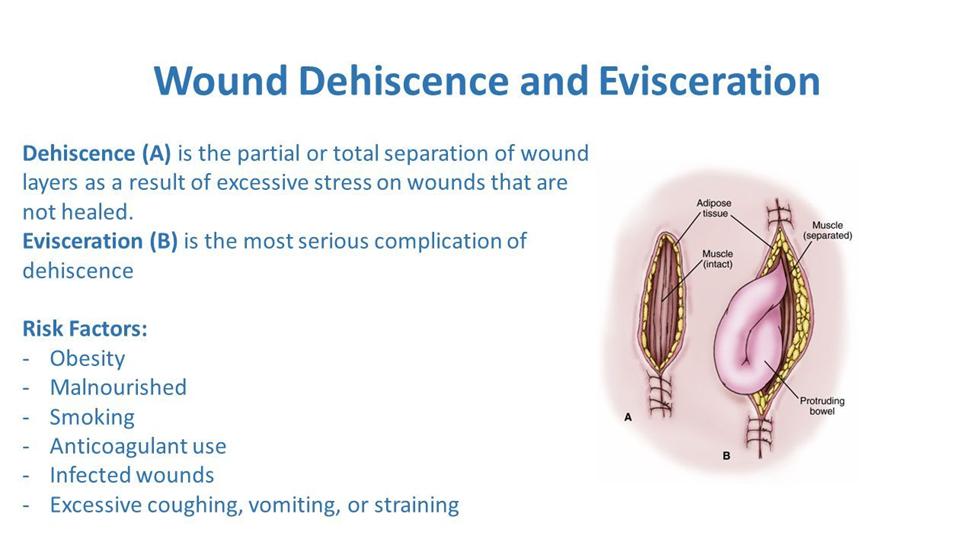
This is the correct and immediate priority. Evisceration, where internal organs protrude through the surgical incision, is a surgical emergency. Returning the client to the operating room is necessary to assess the extent of the complication, address the wound dehiscence, and protect the exposed organs. This intervention aims to prevent further complications and provide necessary surgical interventions.
B. Obtain a sample of the drainage to send to the lab:
While obtaining samples for laboratory analysis can be important for infection control, in the context of a client with evisceration, the primary concern is the surgical emergency. The priority is to address the wound complication by returning to the operating room rather than focusing on laboratory analysis at this immediate moment.
C. Bring additional sterile dressing supplies to the room:
While bringing additional supplies may be necessary, the priority in this situation is to prepare for the client's return to the operating room. Once the client is in a controlled surgical environment, additional dressing changes and wound care can be performed as needed.
D. Auscultate the abdomen for bowel sound activity:
While monitoring bowel sounds is a routine nursing assessment, in the context of evisceration, the immediate concern is the exposure of internal organs and the risk of infection. Preparing for the operating room takes precedence over routine assessments.
Correct Answer is C
Explanation
A. Hyperactive bowel sounds.
Hyperactive bowel sounds are more suggestive of gastrointestinal issues, such as intestinal hypermotility or increased peristalsis. While diabetes can affect the gastrointestinal system, hyperactive bowel sounds are not a specific indicator of the symptoms described by the client.
B. Anxiety and sighing.
Anxiety and sighing are more indicative of emotional or psychological factors rather than dehydration. While stress can impact blood sugar levels in individuals with diabetes, anxiety and sighing are not direct signs of the dehydration that may be associated with the reported symptoms.
C. Dark yellow urine.
Dark yellow urine can be a sign of concentrated urine, suggesting dehydration. In diabetes, especially when blood sugar levels are elevated, increased urine production (polyuria) can lead to dehydration. Dark yellow urine may indicate that the urine is more concentrated due to a lack of fluid intake.
D. Myalgia in wrists and hands.
Myalgia in the wrists and hands is not a typical symptom of dehydration related to diabetes. It could be associated with various conditions, such as musculoskeletal issues or nerve-related problems. This symptom is less likely to be directly linked to the reported weakness and palpitations.
Whether you are a student looking to ace your exams or a practicing nurse seeking to enhance your expertise , our nursing education contents will empower you with the confidence and competence to make a difference in the lives of patients and become a respected leader in the healthcare field.
Visit Naxlex, invest in your future and unlock endless possibilities with our unparalleled nursing education contents today