
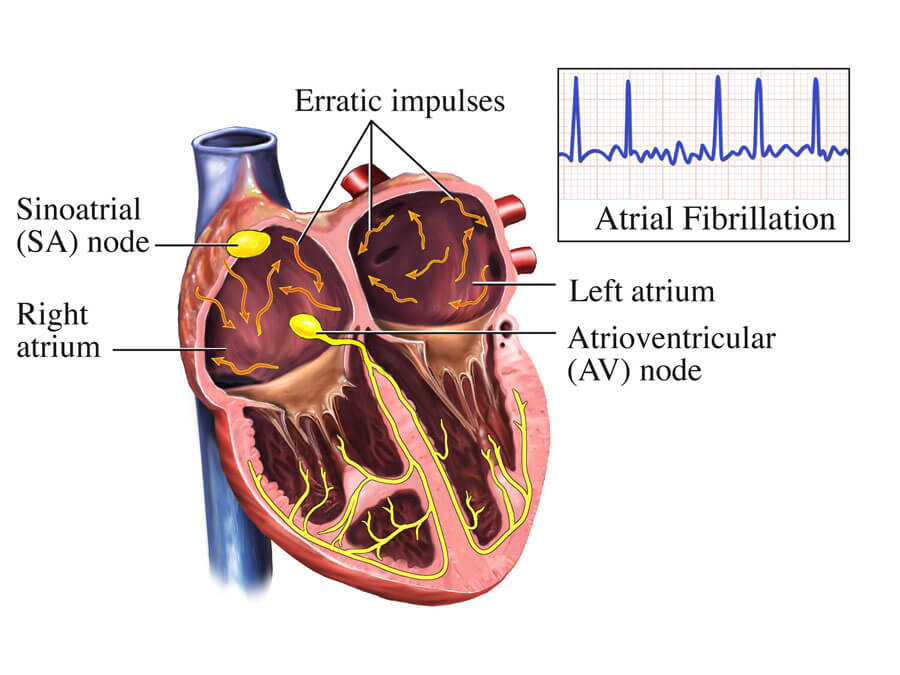
A nurse is reinforcing teaching about warfarin with a client who has a new onset of atrial fibrillation. Which of the following statements should the nurse include in the teaching?
"Warfarin dissolves clots in the bloodstream."
"This medication slows the response of the ventricles to the fast atrial impulses."
"Warfarin helps prevent strokes in clients who have atrial fibrillation."
"This medication will help maintain a normal heart rhythm."
The Correct Answer is C
Choice A reason : The statement that warfarin dissolves clots in the bloodstream is incorrect. Warfarin does not dissolve existing clots. Instead, it is an anticoagulant that works by decreasing the production of certain clotting factors in the blood, which helps prevent the formation of new clots.
Choice B reason : This statement is not accurate regarding the action of warfarin. Warfarin does not affect the electrical impulses of the heart. Medications that slow the response of the ventricles to fast atrial impulses are typically antiarrhythmic drugs, not anticoagulants like warfarin.
Choice C reason : This is the correct statement. Warfarin is prescribed for clients with atrial fibrillation to reduce the risk of stroke. Atrial fibrillation increases the risk of forming blood clots in the heart, which can then travel to the brain, causing a stroke. Warfarin's anticoagulant effect helps to prevent these clots from forming.
Choice D reason : Warfarin does not help maintain a normal heart rhythm. It is not an antiarrhythmic drug but an anticoagulant. The purpose of warfarin in atrial fibrillation is to prevent stroke by reducing the risk of clot formation, not to correct the heart rhythm.
Nursing Test Bank
Naxlex Comprehensive Predictor Exams
Related Questions
Correct Answer is D
Explanation
Choice A reason: Scheduling the next appointment for 1 year from now is a standard practice for patients who are considered to be in good health and have no immediate medical concerns. Given the patient's normal BP and BMI, along with no reported medical problems, this would typically be an appropriate action. However, it is essential to consider the patient's age and race, as African American men are at a higher risk for certain conditions, such as prostate cancer, which may warrant more frequent monitoring.
Choice B reason: While providing information for a weight loss plan that includes increasing physical activity is generally beneficial, it may not be necessary for this patient. His BMI is 24, which falls within the normal range (18.5-24.9), indicating that he is not overweight. Therefore, unless the patient expresses a desire to lose weight or improve fitness, this action might not be a priority.
Choice C reason:Offering information on reducing risk factors for hypertension is always a positive step in preventive healthcare. However, the patient's BP is 126 mm Hg, which is considered a normal reading (normal BP range is 90/60 mm Hg to 120/80 mm Hg). Therefore, while education on maintaining a healthy lifestyle is valuable, it may not be the most critical action for this visit.
Choice D reason:Scheduling a PSA test is recommended for African American men starting at age 45 due to their increased risk of prostate cancer. The PSA test measures the level of prostate-specific antigen in the blood, which can be an indicator of prostate cancer. Given the patient's demographic, this proactive screening measure is advisable, despite the absence of symptoms or previous medical problems.
Correct Answer is B
Explanation
Choice A reason: Cough is not commonly associated with atenolol. Atenolol is a beta-blocker used to treat hypertension and is less likely to cause respiratory side effects compared to some other classes of antihypertensive medications.
Choice B reason: Bradycardia, or a slower than normal heart rate, is a well-documented adverse effect of atenolol. Atenolol works by blocking beta-1 receptors in the heart, which can reduce the heart rate. Normal heart rate ranges for infants (1 to 11 months old) are 80-160 beats per minute (BPM), and for toddlers (1-2 years old), it's 80-130 BPM. Bradycardia would be defined as a heart rate below these normal ranges. It is important for patients starting atenolol to monitor their pulse regularly and report any significant decrease in heart rate to their healthcare provider.
Choice C reason: While constipation can be a side effect of many medications, it is not a common adverse effect of atenolol. Atenolol does not typically affect the gastrointestinal system to the extent that it causes constipation.
Choice D reason: Headache is not a typical adverse effect of atenolol. While headaches can occur for a variety of reasons, they are not directly linked to the pharmacological action of atenolol on the cardiovascular system.
Whether you are a student looking to ace your exams or a practicing nurse seeking to enhance your expertise , our nursing education contents will empower you with the confidence and competence to make a difference in the lives of patients and become a respected leader in the healthcare field.
Visit Naxlex, invest in your future and unlock endless possibilities with our unparalleled nursing education contents today