
A nurse is reinforcing teaching with a client about the use of budesonide for asthma management.
Which of the following statements by the adolescent indicates an understanding of the teaching?
"I will take my inhaler treatment before each meal and at bed time."
"I should use my inhaler when I have an asthma attack."
"I should use my inhaler before exercising."
"I will rinse my mouth and gargle with water after each inhaler treatment."
The Correct Answer is D
Budesonide is a corticosteroid inhaler used for long-term management of asthma. It helps to reduce inflammation and prevent asthma symptoms. Rinsing the mouth and gargling with water after using a corticosteroid inhaler can help reduce the risk of developing oral thrush, a fungal infection.
The other statements are incorrect and indicate a misunderstanding of the teaching: "I will take my inhaler treatment before each meal and at bedtime": Budesonide is not typically used before meals or at bedtime. It is usually taken on a regular schedule, as prescribed by the healthcare provider, to provide long-term control of asthma symptoms.
Using the inhaler before exercising is important because physical activity can trigger asthma symptoms in some individuals. By using the inhaler before exercise, the client can help prevent exercise-induced asthma symptoms. However, this depends on the degree of difficulty of the exercise.
"I should use my inhaler when I have an asthma attack": Budesonide is not a rescue inhaler for immediate relief of asthma symptoms during an asthma attack. It is a controller medication meant to be used regularly to prevent symptoms from occurring.
Nursing Test Bank
Naxlex Comprehensive Predictor Exams
Related Questions
Correct Answer is D
Explanation
Explanation
D. Maintain the client in high-Flower’s position
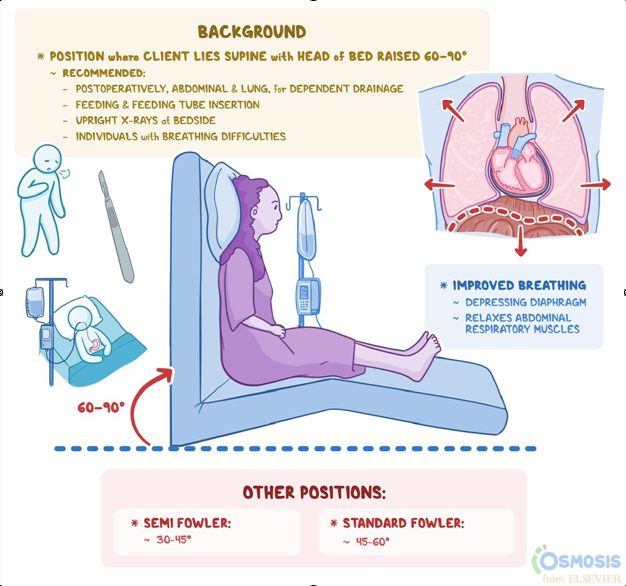
Crackles in the bases of the lungs, shortness of breath, and an increased respiratory rate are signs of pulmonary congestion, which is commonly seen in heart failure. Maintaining the client in a high-Fowler's position, with the head of the bed elevated to a 45-60-degree angle, helps reduce venous return to the heart, decreases fluid accumulation in the lungs, and improves breathing comfort for the client.
The other options are not appropriate actions for the client's condition:
Instructing the client to cough every 4 hours in (option A) is not the priority action in this situation. Coughing may not effectively address the underlying cause of pulmonary congestion and may not provide immediate relief for the client.
Encouraging the client to ambulate to loosen secretions in (option B) is not the priority action in this situation. While ambulation can be beneficial for overall health, the client's symptoms of pulmonary congestion require immediate attention to improve respiratory status.
Increasing the client's intake of oral fluids in (option C) is not the priority action in this situation. While maintaining adequate hydration is important, excessive fluid intake can worsen the symptoms of heart failure and contribute to further fluid accumulation in the lungs.
Therefore, the nurse should maintain the client in high-Fowler's position (option D) to promote optimal lung function and improve breathing comfort. It is important to promptly notify the healthcare provider of the client's condition for further assessment and intervention.
Correct Answer is ["A","B","C","D","E","G"]
Explanation
-
- Request that the client's family bring the client's eyeglasses from home: This is important to ensure that the client has optimal vision and can see clearly, considering their visual loss. Having their eyeglasses will improve their ability to communicate and understand their surroundings.
- Reorient the client often: Reorientation is important for clients who may be disoriented due to their medical condition or unfamiliar environment. Regularly reminding the client of their location, date, and situation can help them maintain orientation.
- Acknowledge the client's feelings: Acknowledging and validating the client's feelings can help establish rapport and promote a therapeutic relationship. It shows empathy and understanding, which can contribute to the client's overall well-being.
- Provide the client with information about what to expect during their care: Providing information to the client about their care helps promote autonomy and active participation in their own healthcare. It can reduce anxiety and improve the client's overall experience.
- Write the full date on the client's whiteboard: Clearly documenting the full date on the client's whiteboard helps the client stay oriented to the current date and time.
- Maintain a well-lit environment: Ensuring a well-lit environment is important, especially for clients with visual impairment. Sufficient lighting can enhance the client's ability to see and navigate their surroundings.
It's worth noting that while asking the client's partner to stay with the client as much as possible may be beneficial, it may not always be feasible or within the nurse's control. Additionally, requesting the client to have the same caregivers with every shift may not be possible due to staffing constraints.
Whether you are a student looking to ace your exams or a practicing nurse seeking to enhance your expertise , our nursing education contents will empower you with the confidence and competence to make a difference in the lives of patients and become a respected leader in the healthcare field.
Visit Naxlex, invest in your future and unlock endless possibilities with our unparalleled nursing education contents today