
A nurse is ambulating a client who catches her foot on the bed frame and begins to fall. Which of the following is an accurate step to prevent or minimize damage from this fall?
The nurse should place his or her feet close together side by side to make themselves have a good center of gravity to assist the patient to the floor.
The nurse should rock his or her pelvis out and try to hold the patient up to prevent falling.
The nurse should grasp the gait belt and push the client’s body backward away from his or her body.
The nurse should use the patients gait belt to gently slide the client down his or her body to the floor.
The Correct Answer is D
A. Placing the nurse's feet close together side by side to have a good center of gravity:
While maintaining a good center of gravity is important, in a falling situation, it's crucial to prioritize the client's safety over the nurse's stability. This option doesn’t address the prevention of the client’s fall.
B. Rocking the nurse's pelvis out and trying to hold the patient up to prevent falling:
Attempting to hold the patient up during a fall may put both the nurse and the client at risk of injury.
C. Grasping the gait belt and pushing the client’s body backward away from the nurse's body:
Pushing the client backward could cause the client to lose balance and fall in an uncontrolled manner.
D. Using the patient's gait belt to gently slide the client down the nurse's body to the floor:
This is the recommended action as it allows for a controlled descent to the floor, minimizing the impact of the fall and reducing the risk of injury to both the client and the nurse.
Nursing Test Bank
Naxlex Comprehensive Predictor Exams
Related Questions
Correct Answer is A
Explanation
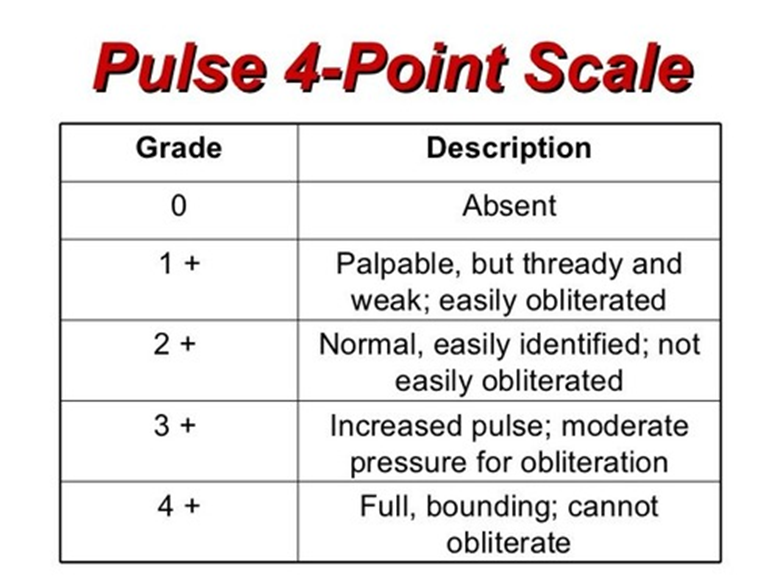
A. Increased, strong:
A pulse amplitude of +3 indicates an increased or strong pulse. This suggests a forceful and palpable pulse, potentially associated with conditions like fever, anemia, or increased cardiac output.
B. Diminished, weaker than expected:
This would typically be associated with a lower than normal pulse amplitude. It might suggest poor peripheral perfusion or decreased cardiac output.
C. Absent, unable to palpate:
If the pulse is absent or unable to be palpated, it could indicate severe conditions such as vascular occlusion or cardiac arrest.
D. Bounding:
A bounding pulse is one with a forceful and strong amplitude. It suggests a powerful expansion of the arterial wall, and it can be associated with conditions like fever, anemia, or increased cardiac output.
Correct Answer is B
Explanation
A. 20 bpm: This is twice the calculated rate, so it's significantly higher than observed.
B. 10 bpm: This matches closely with the calculated rate of approximately 10.23 breaths per minute.
The scenario describes the nurse counting the client's breaths starting from when the second hand of the clock was at 12 and ending just past 5, and the client completed 9 breaths during this time frame.
Counting Period:
From just past 12 to just past 5 on the clock, the time span is approximately 53 seconds.
Number of Breaths:
The client completed 9 breaths within this time frame.
Now, to calculate the respiratory rate:
Respiratory rate = (Number of breaths / Time in minutes)
Respiratory rate = (9 breaths / 0.88 minutes) (53 seconds converted to minutes)
After calculation, the respiratory rate is approximately 10.23 breaths per minute.
C. 09 bpm: This is a lower value than observed and doesn't align with the counted breaths.
D. 18 bpm: This is close to double the observed rate, which doesn't match with the counted breaths within the time frame.
Whether you are a student looking to ace your exams or a practicing nurse seeking to enhance your expertise , our nursing education contents will empower you with the confidence and competence to make a difference in the lives of patients and become a respected leader in the healthcare field.
Visit Naxlex, invest in your future and unlock endless possibilities with our unparalleled nursing education contents today