
A nurse is reinforcing teaching with a client who has Crohn’s Disease and is experiencing frequent cramping and diarrhea. Which of the following statements should the nurse include in the teaching?
“Increase your caloric intake by eating foods high in protein.”
“Include fresh fruits and vegetables at each meal.”
“Maintain your weight by eating high fat foods.”
“Drink whole milk to ensure adequate calcium intake.”
The Correct Answer is A
A. “Increase your caloric intake by eating foods high in protein.”
This is the appropriate choice. Increasing caloric intake with high-protein foods can help meet nutritional needs for individuals with Crohn's Disease, especially if malabsorption is a concern.
B. “Include fresh fruits and vegetables at each meal.”
While fresh fruits and vegetables are generally healthy, they may exacerbate symptoms in some individuals with Crohn's Disease, especially during flare-ups. It may be advisable to choose cooked or processed fruits and vegetables to minimize irritation.
C. “Maintain your weight by eating high-fat foods.”
This statement is not advisable. High-fat foods can contribute to symptoms such as cramping and diarrhea in individuals with Crohn's Disease. A well-balanced diet with an appropriate mix of nutrients is generally recommended.
D. “Drink whole milk to ensure adequate calcium intake.”
This statement is not advisable without considering individual tolerance. Whole milk is high in fat and may be difficult to digest for some individuals with Crohn's Disease. Additionally, if lactose intolerance is present, it may worsen symptoms. Alternative sources of calcium may need to be considered.
Nursing Test Bank
Naxlex Comprehensive Predictor Exams
Related Questions
Correct Answer is C
Explanation
A. "Skeletal traction has less risk for infection than skin traction."
This statement is not accurate. Both skeletal and skin traction carry some risk of infection, but the risk factors and considerations are different for each. Skeletal traction involves pins or wires directly inserted into the bone, and while the risk of infection is present, it is not necessarily lower than that of skin traction.
B. "Clients in skin traction have more mobility than those in skeletal traction."
This statement is not accurate. Skeletal traction, involving the use of weights and pins or wires inserted into the bone, tends to provide more stable immobilization. Skin traction, which relies on external devices applied to the skin's surface, may allow for some limited mobility but is generally not as effective as skeletal traction.
C. "Skeletal traction is better than skin traction for reducing a fracture."
This is the correct statement. Skeletal traction is often more effective in providing a stable and controlled environment for reducing and immobilizing fractures.
D. "Clients in skin traction have more discomfort than those in skeletal traction."
This statement is not necessarily accurate. Discomfort can vary depending on the individual, the type of fracture, and other factors. Both skeletal and skin traction may cause some discomfort, and it's important to assess and manage the client's pain appropriately in either case.
Correct Answer is B
Explanation
A. Reduction of the fracture:
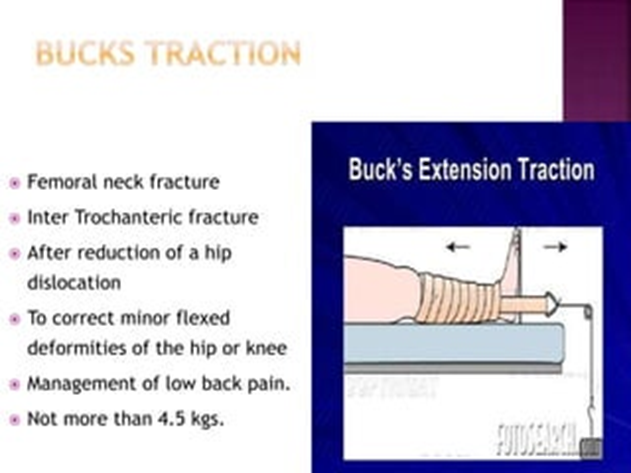
Buck's traction is not primarily intended for the reduction (realignment) of the fractured bones. While it may help maintain proper alignment, the primary goal is to provide temporary immobilization and relieve muscle spasms until more definitive treatment, such as surgery, can be performed.
B. Relief from muscle spasms:
This is the correct answer. Buck's traction is commonly used to alleviate muscle spasms associated with hip fractures. The traction force helps to relax the muscles, reduce pain, and maintain the alignment of the fractured bones.
C. Alignment of the pins:
Buck's traction does not involve the insertion of pins into the bone. It uses a boot attached to the leg, and the traction force is applied externally to the limb to achieve the desired therapeutic effects.
D. Support for moving the extremity:
Buck's traction is not intended to support active movement of the extremity. Instead, it provides temporary immobilization to prevent further injury and facilitate the healing process before more definitive interventions, such as surgery, are undertaken.
Whether you are a student looking to ace your exams or a practicing nurse seeking to enhance your expertise , our nursing education contents will empower you with the confidence and competence to make a difference in the lives of patients and become a respected leader in the healthcare field.
Visit Naxlex, invest in your future and unlock endless possibilities with our unparalleled nursing education contents today