






 Video Library


Rn fundamentals 2019 Proctored Exam
Rn fundamentals 2019 Proctored Exam
Total Questions : 65
Showing 10 questions Sign up for moreA nurse is caring for a client who consumes 3 oz of milk, 2 oz of orange juice, 3 oz of tea, and 4 oz of water over a 4-hr period. The client is also receiving dextrose 5% in 0.45% sodium chloride 30 mL/hr by continuous IV infusion. Calculate the client's intake for that 4-hr period in mL. (Round the answer to the nearest whole number. Use a leading zero if it applies. Do not use a trailing zero.)
Explanation
1oz= 29.57 mL
Total oral intake= 3+2+3+4= 12oz 12oz x 29.57= 354.84 ml
Total IV 30ml/hr x 4= 120 ml Total= 354.84 +120
= 474.84 ml
= 475 ml (rounded off to the nearest whole number)
A nurse is preparing a sterile field to assist with suturing a client's laceration. Which of the following actions should the nurse plan to take?
Explanation
Choice A rationale: Placing the lid face down on the sterile drape contaminates the sterile field, as the outer surface of the lid is not considered sterile.
Choice B rationale: Applying sterile gloves before opening the bottle of sterile solution is important to maintain asepsis and prevent contamination of the field.
Choice C rationale: Pouring sterile solution with the bottle held 20 cm (8 in) above the sterile bowl helps prevent contamination by minimizing the risk of airborne microorganisms entering the solution.
Choice D rationale: Holding the bottle with the label facing the palm helps prevent drips or spills on the label, maintaining the sterility of the solution.
A nurse is assessing a client who is receiving continuous IV fluids through a peripheral IV. Which of the following findings indicates to the nurse that the client is experiencing fluid overload?
Explanation
Choice A rationale: Crackles in the lungs indicate fluid overload, as excess fluid can accumulate in the alveoli, causing crackling sounds during breathing.
Choice B rationale: Bradycardia is not typically associated with fluid overload; tachycardia is a more common sign.
Choice C rationale: Fever is not a direct indicator of fluid overload but may be associated with other conditions.
Choice D rationale: Flattened neck veins are not indicative of fluid overload; distended neck veins are more likely to be seen in this condition.
A visitor reports to a nurse that she slipped and fell in a client's room. The visitor denies any injury, but is walking with a slight limp. Which of the following actions should the nurse take?
Explanation
Choice A rationale: While risk management may be involved later, the immediate action is to complete an incident report to document the details of the visitor's fall.
Choice B rationale: Administering acetaminophen to the client is not relevant to the visitor's fall and limp.
Choice C rationale: Documenting the occurrence in the client's medical record is important, but completing an incident report is the priority to ensure a thorough investigation and follow-up.
Choice D rationale: Completing an incident report is the priority to ensure a thorough investigation and follow-up. It is crucial for maintaining an accurate record of the event, identifying potential hazards, and implementing preventive measures.
A nurse at an assisted living facility is preparing an in-service for residents about electrical safety. Which of the following instructions should the nurse include?
Explanation
Choice A rationale: Cleaning electrical equipment is important for infection control but is not directly related to electrical safety.
Choice B rationale: Disconnecting electrical equipment by grasping the plug is a safe practice, as pulling on the cord can damage the cord and create a safety hazard.
Choice C rationale: Taping electrical cords to the floor can create a tripping hazard and is not recommended for electrical safety.
Choice D rationale: Covering exposed wires with tape is not a recommended practice, as it may not provide adequate protection and can create a fire hazard.
A nurse is preparing to administer several medications to a client. Which of the following data should the nurse plan to use to confirm the client's identity?
Explanation
Choice A rationale: The client's admitting diagnosis is not a reliable identifier for confirming the client's identity.
Choice B rationale: The client's telephone number is a unique identifier and can be used to confirm the client's identity before administering medications.
Choice C rationale: The name of the client's next of kin is not a direct identifier of the client and should not be used for confirmation.
Choice D rationale: The client's room number is not a unique identifier and may not accurately confirm the client's identity.
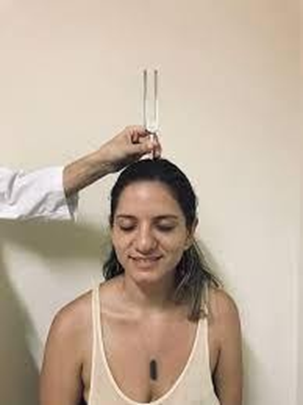
A nurse is testing a client for conduction deafness by performing the Weber's test. Which of the following actions should the nurse take when performing this test?
Explanation
Choice A rationale: To perform the test, the nurse should strike a tuning fork and place its base on the top of the client's head. The client should then report if they hear the sound equally in both ears, or louder in one ear. If the sound is louder in one ear, it indicates that there is either a conductive hearing loss in that ear, or a sensorineural hearing loss in the opposite ear.
Choice B rationale: Placing the base of a vibrating tuning fork on the client's mastoid process is the technique for the Rinne's test and not Weber’s test.
Choice C rationale: Counting how many seconds a client can hear a tuning fork after it has been struck is not a component of the Weber's test.
Choice D rationale: Moving a vibrating tuning fork in front of the client's ear canals one after the other is not the correct procedure for the Weber's test but is instead used in Rinne test.
A nurse is providing preoperative teaching to a client over the phone in preparation for outpatient surgery. Which of the following information should the nurse include in the teaching?
Explanation
Choice A rationale: Wearing makeup during surgery is typically discouraged to prevent interference with monitoring equipment and to maintain a sterile environment.
Choice B rationale: Explaining the need to have another adult drive the client home is important due to the potential effects of anesthesia, which can impair the client's ability to drive and make decisions.
Choice C rationale: Showering three times the day before surgery is excessive and not a standard preoperative practice.
Choice D rationale: The client should stop drinking clear liquids 2 hrs before surgery. However, the guidelines for fasting but may vary depending on institutional policies.
A nurse is preparing to insert a peripheral IV catheter into a client's arm. Which of the following actions should the nurse take to help dilate the vein?
Explanation
Choice A rationale: The nurse should instruct the client to relax their arm and keep their hand open, but not to flex their arm, as this can reduce blood flow and make the vein less prominent.
Choice B rationale: Applying a cool compress to the vein for 10 minutes may cause vasoconstriction and make the vein less dilated.
Choice C rationale. Stroking the skin near the vein in an upward direction is incorrect. Stroking should be done in a downward direction, toward the fingers, to help push blood into the vein and make it more visible.
Choice D rationale. Dangling the client's arm over the edge of the bed is correct. This helps use gravity to promote venous filling, making the veins more prominent and easier to access for IV insertion.
A nurse is preparing to bathe a client who has dementia. Which of the following actions should the nurse take?
Explanation
Choice A rationale: Using distractions, such as music or gentle conversation, can help make the bathing experience more comfortable for a client with dementia.
Choice B rationale: Giving detailed instructions may be confusing for a client with dementia, as they may have difficulty processing and remembering information.
Choice C rationale: If the client is in distress during the bath, it is essential to modify the approach or consider alternative methods to ensure their comfort and well-being.
Choice D rationale: Allowing the client to select the temperature of the bath water may pose a safety risk, as they may not accurately assess or communicate their preferences.
You just viewed 10 questions out of the 65 questions on the Rn fundamentals 2019 Proctored Exam Exam. Subscribe to our Premium Package to obtain access on all the questions and have unlimited access on all Exams. Subscribe Now